

DIGNIFIED INDEPENDENCE
Policy Brigade
Cluster Coordinator Foundation Programme,
Community Participation, Operations Control and Employment Progression
Policy Brigade is the community coordination, verified-information and responsible follow-through framework within the Dignified Independence institutional ecosystem. It creates a local point of contact through which individuals and families can explain a genuine need, understand the available pathway, connect with the appropriate service or authorised professional, and
receive accountable follow-up.
Dignified Independence coordinates 313 specialised services through 88 departments within a wider 14 entity institutional ecosystem. Policy Brigade provides the local access and coordination layer for this framework. Its community field functions include Cluster Coordination, Sympathiser participation, Representative Volunteer participation, public-information support, customer relations, service routing, reporting, complaint escalation and community operations.
Policy Brigade is non-partisan and operates independently. It does not represent the United Nations, a government, a political party, a regulator or another institution merely because its work may align with relevant Sustainable Development Goals or public-interest objectives. Any reference to such alignment describes programme purpose only and does not imply affiliation, endorsement or representation.
The purpose of Policy Brigade
The purpose is not to sell a fixed service or pressure people to open files. It is to:
• listen carefully and understand the person’s actual circumstances;
• identify genuine needs, access barriers and urgent concerns;
• explain only verified and authorised information;
• connect the person with the correct DI service, public authority, help desk or authorised professional;
• maintain an accurate record of accepted actions and pending steps;
• follow up until the matter is completed, transferred, withdrawn, found ineligible or formally closed; and
• protect dignity, consent, confidentiality, accessibility and professional boundaries throughout the process.
Who may be supported
The framework may support any eligible individual or family requiring verified information, service
navigation, community coordination or an authorised referral. Particular attention is given to people
who may face serious barriers to access, including:
• persons with disabilities;
• older persons;
• people living with serious illness or long-term dependency;
• vulnerable or underserved families;
• people facing language, literacy, geographic, financial or digital-access barriers; and
• people who require reasonable accommodation, accessible communication or supported decisionmaking.
Mission
To create an ethical and accountable community-level network that helps people understand verified policies and services, identify relevant needs, connect with the correct support pathway and
receive responsible follow-up through completion, authorised referral or documented closure.
Vision
A society in which every person can access a trustworthy local point of contact for verified information, humanitarian coordination, service navigation and community participation, regardless of disability, age, illness, income, language, geography or digital ability.

Core values
Dignity: Every person must be heard respectfully without degrading labels, pressure or discrimination.
Accuracy: Information must come from an approved and current source. Uncertainty must be stated honestly, and verified errors must be corrected promptly.
Neutrality: No member may use the role to campaign for a political party, candidate, government or private interest.
Accessibility: Communication must be adapted, where reasonably possible, to the person’s disability, language, literacy, age and preferred method of understanding.
Confidentiality: Only necessary information may be collected, and it may be used or shared only for an authorised purpose through an approved route.
Professional boundaries: Clinical, legal, financial, engineering and other reserved decisions must be referred to appropriately qualified and authorised professionals.
Accountability: Actions, referrals, follow-up, corrections, complaints and closure must be traceable and open to authorised review.
Quality before quantity: Complete, accurate and responsible service takes priority over activity figures, hurried expansion or unnecessary file creation.
What Policy Brigade Does
Policy Brigade combines community mobilisation, verified public-information support, service
navigation, customer relations and local field coordination. It does not replace a government authority,
emergency service, regulator or licensed professional.
Community enquiry and need identification
Members listen to the person, clarify the request, identify immediate risk and record only the minimum
information required for the authorised next step.
Verified policy and procedure awareness
Members may explain verified public policies, welfare schemes, official procedures, eligibility
statements, application routes and service contacts in clear language. They must identify the responsible
authority and must not present an opinion as law or official policy.
DI service navigation
An accepted enquiry may be connected with the appropriate one of DI’s 88 departments, 313
specialised services, help desks or authorised professionals. The member must remain within the
authority of their recorded role.
Accessible communication and Inclusive Adaptation
People who face disability, language, literacy, age-related or digital barriers may be supported through
accessible explanations, reasonable accommodation, assisted communication and an adapted service
route where reasonably possible.
Referral, follow-up and continuity
Where a different department, public authority or professional must act, the matter is referred through
the approved route. Follow-up continues so that delay, missing requirements, customer concerns or
service failure can be identified and escalated responsibly.
Customer relations and complaint routing
Members may receive service concerns, explain the complaint process, protect complainants from
retaliation, avoid conflicts of interest and track the authorised response. A person whose own conduct is
involved in a complaint must not control the review.
Community feedback
Consent-based feedback may be collected to understand service gaps and operational needs. Public
reporting must use verified and authorised information and must not expose personal data or
manipulate community opinion.
Standard Community Support Pathway
1. Listen and obtain consent. Understand the person’s question, communication preference, immediate risk and permission to record or refer information.
2. Classify and verify. Identify whether the matter concerns a DI service, public policy, humanitarian need, complaint, emergency or reserved professional issue.
3. Provide verified information. Explain only information supported by an approved source and identify important limitations, eligibility conditions and responsible authorities.
4. Route the request. Connect the matter with the appropriate DI department or service, public authority, help desk or authorised professional.
5. Coordinate and follow up. Maintain the reference, monitor the agreed next step and escalate delay, risk, complaint or service failure through the correct channel.
6. Review and close. Record the outcome, authorised referral, unresolved need, withdrawal, ineligibility or reason for formal closure.
Emergency boundary
Policy Brigade is not a substitute for an emergency-response service. A threat to life, serious violence,
medical emergency, missing child, disaster or immediate safeguarding danger must first be referred to
the appropriate local emergency or statutory service. A Policy Brigade member may provide safe
coordination and follow-up after the emergency route has been activated, but must not delay
emergency assistance.
Community Operating Structure
Policy Brigade is designed as a micro-local network so that support begins close to where people live and
escalates through a defined line of accountability.
Sympathiser
A Sympathiser is a self-directed community supporter. This is not a vacancy, staff appointment or
registered Representative Volunteer status. A Sympathiser may share approved information, identify
needs, support awareness activities and refer people through the authorised route.
Representative Volunteer
A Representative Volunteer is a formally registered voluntary participant. Registration records the
volunteer status and may permit an eligible identity card. It does not create employment, salary, an
exclusive permanent area, professional authority or a guarantee of later appointment.
Cluster Coordinator
A Cluster Coordinator is the primary community-level coordinator for an officially assigned local cluster,
normally centred around the Coordinator’s residence and planned around approximately 1,000 families.
The Coordinator receives enquiries, routes services, coordinates follow-up, supports volunteers,
maintains records and reports through the authorised operational structure.
Operations Control and Customer Relations Officer
The Operations Control and Customer Relations Officer, referred to in this document as the OCCR
Officer, supervises field operations, Cluster Coordinator performance, customer relations, complaint
handling, quality control, reporting and cross-cluster operational needs. One OCCR Officer is normally
assigned approximately 10 to 15 Cluster Coordinator areas. A reference of approximately 10 to 15
kilometres may be used for planning, but the number of assigned Cluster Coordinator areas is the
primary standard and kilometres are not an inflexible boundary.
Escalation line
A Sympathiser or Representative Volunteer normally refers an accepted matter through the assigned
Cluster Coordinator. The Cluster Coordinator refers operational, customer-relations and unresolved
matters to the OCCR Officer. Matters requiring professional judgement, statutory authority,
safeguarding intervention or another DI service are escalated to the relevant authorised department,
public authority or professional.
Local Area and Residency Eligibility
These community roles are designed for people who understand and are genuinely connected with the local operational area.
Compulsory local residency
The applicant or participant must satisfy one of the following:
• at least 5 years of continuous residence in the operational area; or
• at least 10 years of cumulative residence in that area where residence has not been continuous.
This local-residency condition is compulsory and has no discretionary exception under the present
framework.
Verification of residency
The person must provide:
• appropriate official supporting documentation;
• a self-declaration confirming the residence history; and
• cooperation with any lawful verification through the relevant authority, local residents or
community sources.
Initial identity, area and suitability checks may be completed before public-facing activation or training
access where required. Final document, identity, background and eligibility verification must be
completed before an appointment becomes effective.
Cluster Coordinator, Sympathiser and Representative Volunteer area
The person’s home is the normal centre or reference point for a cluster of approximately 1,000 families.
A distance of around one kilometre may be a useful reference and a practical local range may extend to
approximately one to two kilometres. The exact assignment depends on:
• family and population density;
• rural or urban geography;
• transport and accessibility;
• safety and local boundaries;
• language and community relationships;
• existing staff allocation;
• service demand; and
• operational requirements.
Family, population and distance figures are planning norms rather than territorial ownership. No
participant may claim an area that has not been officially assigned.
OCCR Officer area
An OCCR Officer is normally responsible for 10 to 15 Cluster Coordinator areas around the officer’s local
home area. The commonly used 10 to 15 kilometre reference helps visualise the likely surrounding area,
but actual coverage is determined by the assigned Cluster Coordinator areas, geography, population,
access and workload.
Participation and Employment Pathways
The framework provides four clearly separated categories:
1. Sympathiser – free, self-directed community participation;
2. Representative Volunteer – registered voluntary participation;
3. Direct Cluster Coordinator – structured training and employment progression; and
4. Operations Control and Customer Relations Officer – advanced structured training and supervisory employment progression.
Membership, volunteering, training, assessment, an identity card or a learning-area allocation does not by itself create employment, salary, statutory authority, professional authority or a guarantee of future appointment.
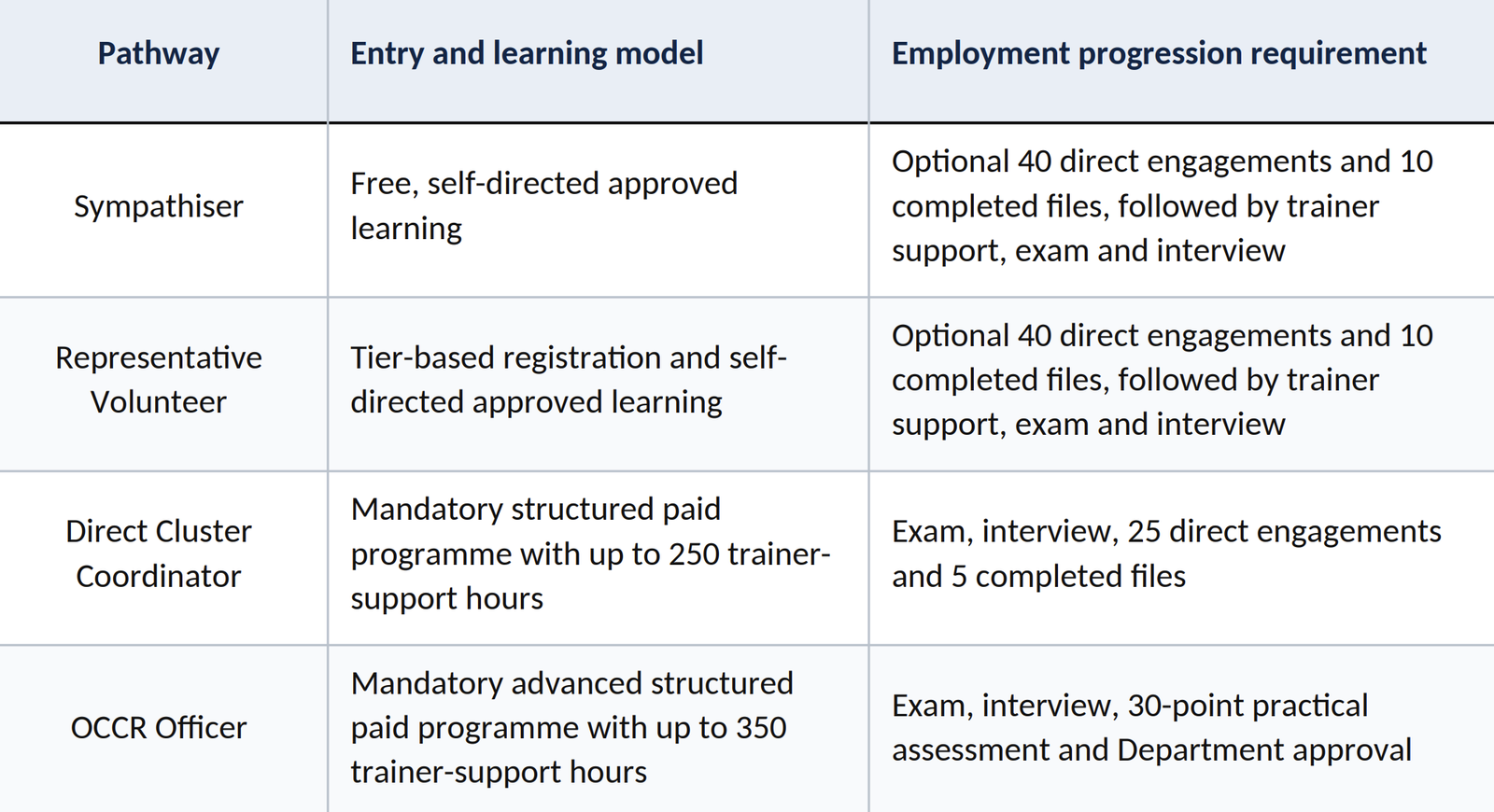
Direct Cluster Coordinator training is mandatory for the direct pathway
A person applying directly through the Cluster Coordinator employment-progression pathway must
enrol in the applicable paid structured training programme. The learning model combines self-study
with trainer-supported clarification, but enrolment in the structured programme is a compulsory part of
the direct pathway.
A person who does not wish to enrol in the direct paid training programme may begin as a Sympathiser
or Representative Volunteer, study independently and, if they later choose employment progression,
complete the separate volunteer-progression requirements described below.
Payment never purchases employment
The direct programme fee pays for the stated training, trainer-support entitlement, coordination,
readiness evaluation, examination and interview process. It is not a recruitment fee, placement fee,
employment fee or payment for a job. Selection and appointment remain subject to eligibility,
verification, learning, assessment, practical performance, conduct, operational need, available position
or cluster, departmental approval, formal documentation and applicable law.
Equal Opportunity and Basic Eligibility
Education
Traditional academic qualifications are not an entry barrier for the Sympathiser, Representative
Volunteer or Cluster Coordinator pathways.
Traditional academic education is also not a compulsory entry barrier for the OCCR Officer pathway. No
general degree, diploma or minimum external-experience requirement applies to this pathway.
Why external experience is not required for the OCCR Officer
The essential competence for the OCCR role relates to DI’s own 14-entity structure, 88 departments, 313
services, policies, Standard Operating Procedures, administration system, customer-relations framework
and field-control process. This knowledge is organisation-specific and is assessed through the approved
training, examination, interview and practical process rather than through a general external-experience
minimum.
Age and gender
There is no organisational maximum age limit and no gender restriction. The minimum lawful age and
any role-specific safety requirement remain subject to the applicable law and nature of the duties.
Non-discrimination and reasonable accommodation
Eligible participation is welcomed without discrimination based on disability, health condition, sex,
gender, ethnicity, language, religion, nationality, social origin or economic condition. Selection remains
subject to essential role duties, reasonable accommodation, safeguarding, verified competence, current
operational need and applicable law.
Required communication ability
Cluster Coordinator, Sympathiser and Representative Volunteer participants do not need full computer
literacy. They must, however, be capable of maintaining official reporting and communication through
WhatsApp or another approved method. Ownership of a particular smartphone is not compulsory;
reliable authorised communication is the requirement.
Additional compulsory skills for the OCCR Officer
The OCCR Officer must have:
• effective communication and listening ability;
• English reading and writing ability;
• basic spoken English sufficient for operational communication;
• email and approved messaging ability;
• basic document handling;
• spreadsheet and data-entry ability;
• CRM or authorised system usage;
• online form and digital report-submission ability; and
• the capacity to learn and apply administration, customer relations, policy, SOP and supervisory
procedures.
Sympathiser Pathway
Status and purpose
The Sympathiser pathway is a free, flexible and self-directed way to support the community. It is
intended for people who wish to learn, share approved information, identify genuine needs and assist
responsible referrals without entering a paid training programme or formal volunteer-registration
process.
The pathway is not merely for people who cannot pay. It is a freedom-based participation model for
anyone who prefers independent learning and voluntary community service.
What a Sympathiser may do
A properly activated Sympathiser may:
• learn the basic Policy Brigade mission, ethics and official contact routes;
• study approved websites, public materials, policies and SOP information independently;
• share only current and approved public information;
• identify a person who may require support;
• connect that person, with consent, to the official enquiry or cluster route;
• support approved awareness, inclusion and community-participation activities;
• report suspected fraud, misinformation, exploitation or safeguarding concerns; and
• complete eligible service responsibilities and receive a file-specific incentive where the applicable
policy permits.
What a Sympathiser may not do
A Sympathiser must not:
• represent themselves as an employee, officer, registered Representative Volunteer, licensed
professional or government representative;
• collect money, identity documents, health records or signatures without separate written
authority for a specific process;
• promise a benefit, job, loan, visa, service outcome or government approval;
• independently manage or approve a case outside the assigned authority;
• supervise staff or volunteers;
• issue an organisational decision; or
• claim an exclusive cluster or permanent area.
Registration, identity card, salary and grant
The Sympathiser pathway has no registration fee and does not provide a Representative Volunteer
registration document or identity card. It does not create entitlement to salary or an operational grant.
Eligible completed and approved service files may qualify for the applicable incentive.
Changing pathway
A Sympathiser may later:
• become a Representative Volunteer by paying the applicable registration fee and completing the
required registration process;
• apply directly for the paid structured Cluster Coordinator programme; or
• remain a Sympathiser and continue the flexible volunteer and incentive pathway without seeking
employment progression.
Representative Volunteer Pathway
Status and purpose
A Representative Volunteer is a formally registered voluntary field participant. The role supports
community awareness, accessible contact, referral, follow-up and participation under the authorised
operational structure.
Registration confirms the recorded volunteer status. It does not confirm employment, salary, a
permanent cluster, immigration sponsorship, professional authority or future appointment.
Core responsibilities
A Representative Volunteer may be authorised to:
• conduct approved community awareness;
• introduce the correct service or enquiry route;
• assist people who face language, literacy, disability or digital-access barriers to communicate their
request;
• refer enquiries and supporting information through the approved system;
• support reminders, follow-up, feedback and approved local activities;
• maintain confidentiality and accurate activity records;
• follow the assigned reporting schedule; and
• complete approved learning, practical files, competency verification and continuing updates.
Authority boundaries
A Representative Volunteer:
• does not independently approve eligibility, fees, funding, professional advice or service outcomes;
• must not retain sensitive records on an unauthorised personal device;
• must not circulate case information in an unapproved group;
• must not collect unofficial payments or use a personal account for organisational transactions;
• must not promise employment or any external approval; and
• remains a volunteer until a separate eligible staff appointment becomes effective.
Registration fee and validity
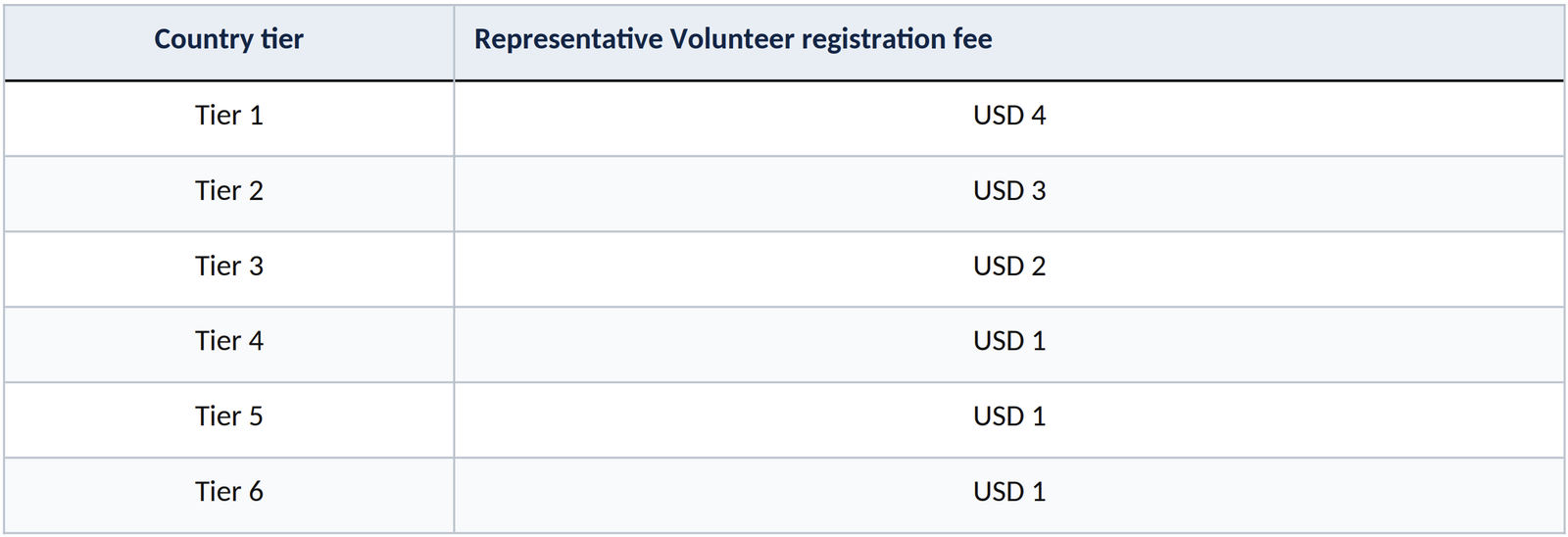
Registration is valid for 365 days.
Automatic renewal
Registration automatically renews for the next 365-day period when the Representative Volunteer
successfully completes their own assigned responsibility in at least one eligible service file during the
current registration period.
There is no automatic right to renew merely by paying the registration fee again. If the qualifying
responsibility is not completed before expiry, the registration expires and any later participation or reregistration is considered under the policy in force at that time.
Optional identity cards
• Digital ID card: approximately USD 5.
• AI-strip based physical ID card: approximately USD 10.
The identity card remains valid only while the underlying Representative Volunteer registration is valid.
The card does not create employment, salary or professional authority.
Refund of identity-card cost
The Representative Volunteer registration fee is non-refundable. The eligible identity-card cost may be
refunded after the person completes the applicable employment-progression pathway, successfully
completes the Institutional Learning Period and receives the employment contract. The registration fee
itself is not refunded.
Salary, grant and incentive
A Representative Volunteer is not entitled to salary or an operational grant merely because registration
has been issued. Each eligible, completed and approved service file may qualify for the applicable filespecific incentive. There is no rule limiting incentive eligibility to the first ten files; every eligible
completed file may be considered under the current incentive schedule.
Optional Cluster Coordinator Progression for Sympathisers and Representative Volunteers
Employment progression is optional. A Sympathiser or Representative Volunteer who does not seek a Cluster Coordinator appointment may continue in the volunteer and incentive pathway without being required to complete the 365-day progression target.
Practical progression requirement
A person who chooses Cluster Coordinator employment progression through either volunteer pathway
must:
• directly engage 40 different individuals or families; and
• successfully complete their own assigned responsibilities in at least 10 eligible service files.
Both requirements must be completed within a maximum of 365 days, calculated from the first valid
service file to the completion of the tenth valid service file.
Every eligible completed file, including files completed beyond the first ten, may qualify for the
applicable incentive.
Free trainer-supported clarification after practical progression
After the required 40 direct engagements and 10 completed files, the participant receives up to 30 hours
of free trainer-supported doubt clarification. This access:
• is valid for 60 days;
• uses the same 30-minute booking and deduction rules as the structured training programme;
• has the same daily trainer-support limit; and
• is intended to close knowledge gaps before formal assessment.
Formal assessment and practical recognition
The participant must then complete the same Cluster Coordinator written examination and interview,
including the same pass marks and re-attempt rules.
The earlier 40 engagements and 10 completed files satisfy the Cluster Coordinator practical
requirement. The participant is not required to repeat the separate 25-engagement and 5-file practical
stage after passing the exam and interview.
Cluster Coordinator Role
Who is a Cluster Coordinator?
A Cluster Coordinator is an authorised community-level coordinator who helps make DI’s 313 specialised
services and relevant public pathways accessible within an assigned local cluster. The Coordinator
understands genuine needs, maintains the local service-access network and connects each accepted
enquiry with the appropriate authorised route.
A Cluster Coordinator is:
• a community representative and local development coordinator;
• a humanitarian service facilitator;
• a customer-support and service-navigation professional;
• a link between the community and specialised departments;
• a field-level documenter and reporter;
• a coordinator of referrals, pending actions, feedback and closure; and
• a guide for Representative Volunteers and Sympathisers within the authorised structure.
A Cluster Coordinator is not:
• a salesperson, door-to-door marketer or commission agent;
• a debt-collection executive;
• an unauthorised financial intermediary;
• a person authorised to guarantee jobs, benefits, loans, visas, services or approvals;
• a substitute for a licensed clinician, lawyer, financial adviser or statutory authority; or
• an owner of the assigned geographical area.
Core responsibilities
A Cluster Coordinator may be required to:
• maintain an accurate local cluster profile and basic resource map;
• understand the community’s service needs and access barriers without profiling or stigmatising people;
• receive enquiries, confirm consent, identify urgency and create the authorised record;
• use the 88-department and 313-service framework to route requests correctly;
• explain verified services, procedures, conditions and limitations;
• coordinate Representative Volunteers and guide Sympathisers without transferring reserved authority;
• support accessible communication, application navigation and community participation;
• monitor referrals, pending actions, customer experience, complaints, outcomes and closure;
• submit accurate activity and case-progress reports;
• escalate safeguarding, legal, professional, operational and customer-relations concerns; and
• perform only the duties authorised by the appointment order, role description, operational instruction and current SOP.
Service-need classification
Neutral service-planning language must be used. The purpose is to plan time, resources, documentation
and follow-up, not to label or rank people.
Active service need: An individual or family currently requires, or has expressed a genuine need for, one
or more eligible services.
No current service requirement: An individual or family has no immediate requirement but may seek
support later.
No person may be pressured, repeatedly solicited, stigmatised or subjected to unnecessary personaldata collection because of this classification.
Approximately six meaningful interactions per working day
A Cluster Coordinator is generally expected to meet or meaningfully engage approximately six
individuals or families during a working day. About one hour may be allocated to each interaction,
adjusted for disability access, urgency, complexity, travel, safety, consent and communication needs.
Each interaction should be used to:
• understand the person or family’s circumstances;
• identify genuine needs and urgent or safeguarding indicators;
• explain relevant verified services and official procedures;
• answer accurately or record what requires authorised clarification;
• obtain consent and collect only appropriate minimum information; and
• identify the correct departmental, professional or statutory next step.
This is an operating reference, not a sales target or automatic payment entitlement.
Five-day work cycle and Work Report
Six meaningful interactions per day across five working days may result in approximately 30 community
interactions. At the end of the authorised five-day cycle, the Coordinator must submit a complete Work
Report through the approved reporting route.
The Work Report should record, as applicable:
• date, locality and safe reference for each interaction;
• the need, question or concern raised;
• consent and any accessibility requirement;
• verified information or guidance provided;
• relevant service, department, authority or referral route;
• documents received through an authorised method;
• actions completed and evidence of completion;
• pending requirement, responsible party and next step;
• customer update and follow-up status;
• complaints, safeguarding or fraud concerns;
• operational obstacles and assistance required; and
• field learning or recommended improvement.
Work Report approval
Submission does not automatically mean approval. The authorised reviewer may:
• approve the report;
• request clarification;
• require correction;
• reject an ineligible item;
• refer a matter for safeguarding, compliance or professional review; or
• issue a Work Report Approval Certificate or equivalent accepted record.
Every Coordinator must submit on time, respond to clarification requests, correct incomplete or
inaccurate information, study feedback, preserve approval references and protect case confidentiality.
Existing service users come first
When approximately 21 customer or service-user files remain active or pending, the Coordinator should
normally pause new identification unless otherwise authorised. Priority must shift to:
• pending documents and verification;
• departmental coordination;
• customer updates;
• delayed cases;
• authorised follow-up; and
• responsible completion or closure.
Additional support when workload is excessive
Where verified workload exceeds the reasonable capacity of one Coordinator, the organisation may
consider an Additional Cluster Coordinator, Assistant Coordinator, temporary operational resource or
department-specific support. No Coordinator should conceal an unmanageable workload, continue
accepting cases that cannot be served responsibly or reduce quality to preserve an activity figure.
Follow-up standard
Follow-up should normally begin in the next working cycle or within the applicable service timeline. It
continues until:
• the service is completed;
• the person withdraws;
• the matter is found ineligible;
• the case is transferred; or
• the organisation formally closes the case with a recorded reason.
Continuous improvement
Policy Brigade uses learning, mentoring, feedback and corrective support rather than unreasonable
pressure. An approximate 50% positive service outcome may be used as an early developmental
benchmark, progressing towards approximately 75% as skill and local knowledge improve.
A positive outcome may include an accurately identified need, eligible response, completed authorised
referral or meaningful case progress. It must not be reduced to a sale, payment or file count. Failure to
meet a developmental benchmark does not automatically terminate employment or volunteer
participation. The review must consider communication quality, case complexity, geography, service
availability, documentation, learning needs and operational barriers.
Working hours and work-life balance
The normal planning framework is:
• approximately 7 hours of professional service per working day;
• normally about 6 hours of direct community interaction;
• approximately 1 hour for documentation, planning, reporting, communication and follow-up;
• a maximum of 5 working days per week;
• approximately 35 working hours per week;
• a maximum of 140 working hours per month; and
• a continuous 48-hour rest period after the completed five-day duty cycle.
Final hours, schedules, holidays, field movement, rest periods and assignments remain subject to the
appointment order, employment contract, operational requirements, applicable policy and local labour
law.
Operations Control and Customer Relations Officer Role
Purpose of the role
The OCCR Officer provides supervisory control across multiple Cluster Coordinator areas, protects
service quality, supports field staff, manages customer-relations systems and maintains traceable
operational decisions.
Core responsibilities
The OCCR Officer may be required to:
• review cluster activation, area coverage, pending cases, reports, referrals and closure quality;
• supervise and support Cluster Coordinators;
• identify capability gaps and arrange approved guidance, correction or escalation;
• monitor customer experience, response time, unresolved enquiries and complaints;
• maintain conflict-free complaint review and protect complainants from retaliation;
• monitor safeguarding concerns and corrective action;
• verify that public information, forms, payment instructions and referrals use approved sources
and channels;
• conduct sample checks, case-record audits, field reviews and local operational meetings;
• coordinate cross-cluster demand, resource gaps and continuity;
• identify and follow local products, production opportunities and authorised organisational
purchase or product-flow requirements;
• prepare area updates and develop appropriate new project or operational plans;
• escalate matters to the relevant DI department, public authority or authorised professional; and
• submit consolidated administration, operational and customer-relations reports.
Authority boundaries
The OCCR Officer:
• cannot override a licensed professional, statutory authority, safeguarding process, financial
control or employment authority;
• must separate complaint review from personal conflicts;
• must escalate an allegation involving their own conduct;
• may not publish policy interpretations, statistics, partnerships or institutional claims without
approval and evidence;
• may not collect unauthorised money or promise an outcome controlled by another body; and
• must act within the written appointment, department authority, SOP and applicable law.
OCCR training emphasis
In addition to the shared DI institutional syllabus, the OCCR programme gives specific and deeper
attention to:
• Administration: operational planning, records, reporting, systems, staff support, area updates,
quality control, resource coordination and departmental escalation.
• Customer Relations: listening, expectation management, response standards, complaint intake,
conflict-free review, written outcomes, service-quality correction, follow-up and customer
protection.
• Cluster Coordinator supervision and performance support.
• Cross-cluster operations, product and production follow-up, organisational activities and local
project planning.
• Policy application, professional boundaries, safeguarding, privacy and fraud prevention.
These are compulsory role competencies and must be clearly recorded in the OCCR training data and
syllabus.
Learning and Competency Framework
Every active participant must understand the organisation, the applicable service framework, their exact authority and the reporting process. There is no authority-without-learning pathway.
Learning routes
Sympathiser and Representative Volunteer: Approved independent self-study using official websites,
authorised materials, policies, SOPs, service information and published guidance.
Direct Cluster Coordinator: Mandatory enrolment in the applicable structured paid programme, with
self-study supported by up to 250 hours of trainer clarification within 180 days.
OCCR Officer: Mandatory enrolment in the applicable advanced structured paid programme, with
deeper administration, customer-relations and supervisory learning supported by up to 350 trainersupport hours within 180 days.
Completion of material, payment of a fee or issue of an identity card does not activate operational authority. Public-facing or staff authority begins only after the organisation records the approved role, status, area, supervisor, permitted systems and effective date.
Core syllabus
The approved syllabus includes:
• the profiles, purposes, functions, responsibilities and relationships of the 14 DI institutions or
entities;
• the purpose, scope, responsibilities, linked services, boundaries and escalation routes of all 88
departments;
• all 313 services, including what each service is, why it exists, who it supports, the need addressed,
intended outcome, responsible department, procedure and boundaries;
• approximately 6,600 frequently asked questions and approved answers;
• organisational policies;
• Standard Operating Procedures;
• role responsibilities, reporting and escalation;
• practical workflow and case management;
• verified information and official-source handling;
• Inclusive Adaptation, accessibility and reasonable accommodation;
• consent, safeguarding, privacy, confidentiality and fraud prevention;
• customer communication and complaint handling; and
• professional conduct and boundaries.
The purpose is not mechanical memorisation of every FAQ. The candidate must understand the
material, identify the correct answer or pathway, verify information, apply it to real situations and
escalate appropriately.
Syllabus version lock
The syllabus version in force on the Official Training Access Activation Date is locked for that candidate’s
training, readiness evaluation, examination, interview and practical assessment. Later routine syllabus
changes do not alter that candidate’s assessment version.
The version lock does not authorise anyone to disregard a new law, emergency safeguarding direction,
mandatory safety instruction or operational control that must legally or immediately apply to live
activity. Such mandatory live-operation requirements must be followed when officially notified, while
the candidate’s assessment remains governed by the locked syllabus unless an authorised transition
instruction states otherwise.
Official Training Access and Validity
When the 180-day period starts
The 180-day validity begins on the Official Training Access Activation Date, not automatically on the
payment date.
The organisation normally aims to activate access within approximately 7 days and must ordinarily
complete activation within a maximum of 15 days after the applicable request and payment.
Choosing a later start date
The candidate may choose an official commencement date up to one month after payment.
If no start date is chosen, the 180-day clock starts automatically on the 31st day after payment. A
candidate may delay active study beyond that date, but the delay is counted within the 180-day validity
and does not pause or extend it.
What the trainer-support entitlement means
The stated hours are the maximum trainer-supported clarification entitlement included in the
programme. They are not compulsory classroom hours and the candidate is not required to use every
available hour.
The candidate studies the approved materials independently and uses trainer time for questions,
explanations, clarification, guidance and readiness support.
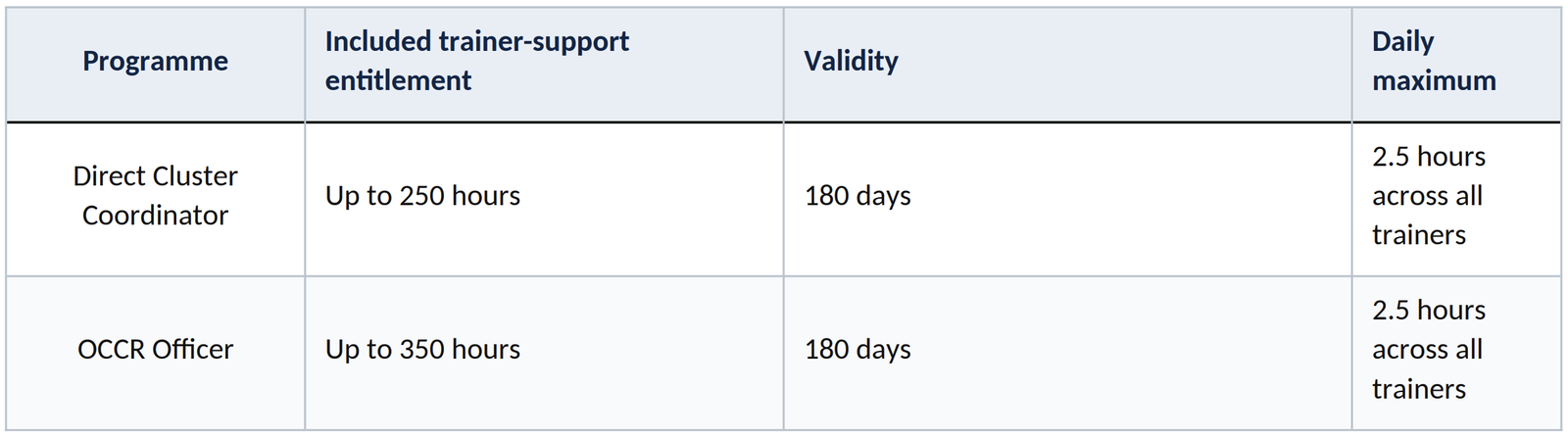
Unused included hours expire at the end of the validity period.
Trainer structure
Different subjects may be supported by different specialist trainers. One Training Coordinator manages
the overall process, records and scheduling.
Communication normally uses recordable and traceable channels such as WhatsApp or CRM-linked
communication. Video may be used when required but is not the normal method for every clarification.
Booking rules
• The minimum slot is 30 minutes.
• Slots must be booked in 30-minute multiples.
• Total trainer-support usage across all subject trainers is limited to 2.5 hours per day.
• A booked slot is deducted in full even if the candidate uses less time. For example, a 60-minute
booking is deducted as 60 minutes even if the discussion ends after 50 minutes.
• Each clarification should normally be handled clearly before moving to the next question within
the booked period.
• The scheduling window closes 24 hours before the slot.
• Before the 24-hour cutoff, the same slot may be rescheduled a maximum of two times.
• A third reschedule is not permitted and the booked time is deducted.
• If the organisation cancels because a trainer is unavailable, the candidate’s entitlement is not
deducted. A suitable trainer swap may be arranged.
Weekday and holiday-availability tracks
The syllabus, fee, validity and assessment standard are the same. The only difference is trainer
availability and scheduling. A holiday-availability track is based on the applicable weekly rest days or
holidays in the relevant country and is not automatically limited to Saturday and Sunday.
Additional trainer-support hours
Additional support may be purchased after the included entitlement is exhausted or where extra
support is otherwise approved.
• Minimum additional purchase: 1 hour.
• Additional hours must be used before the original 180-day validity expires.
• Purchasing additional hours does not extend the original validity.
• Promotional discounts do not apply to additional support.
• The hourly price is calculated as the applicable tier’s normal full training fee divided by the
included trainer-support hours for that programme.
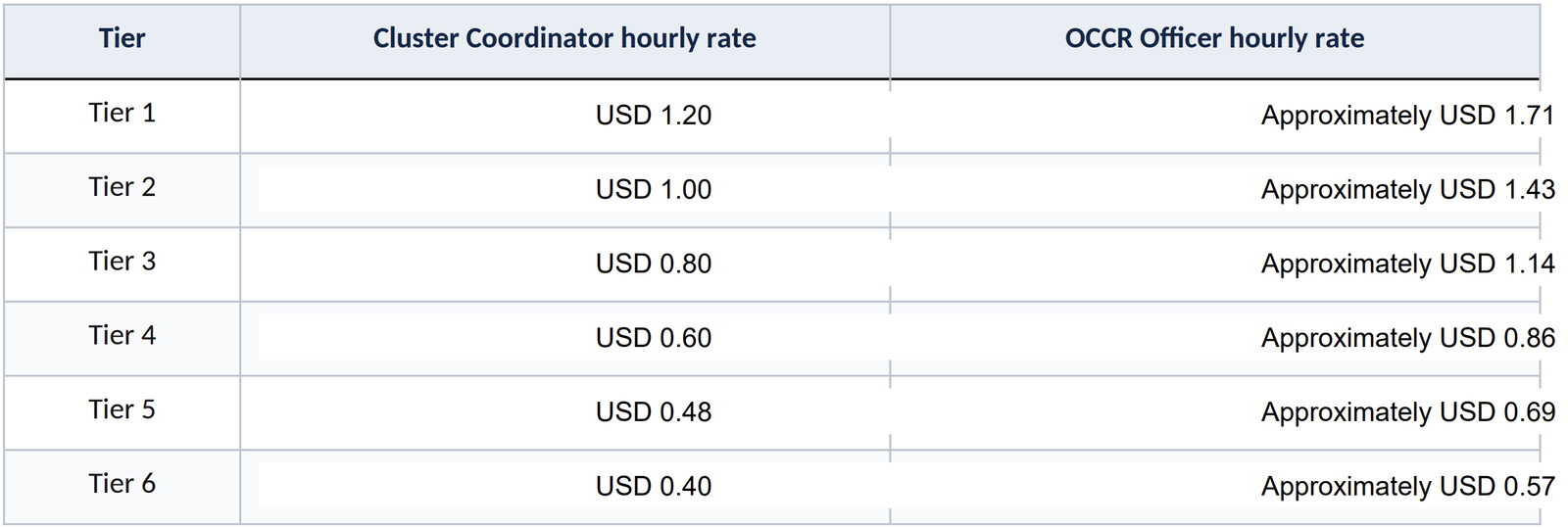
The official invoice uses the exact formula before any normal payment-system or currency rounding.
What the structured programme fee includes
The applicable programme fee includes:
• official training access;
• the included trainer-support entitlement;
• Training Coordinator support;
• trainer readiness evaluation;
• formal written examination;
• interview; and
• the ordinary assessment administration included in the stated pathway.
There is no separate standard examination or interview fee within the initial programme package.
Training-fee refund review
The training fee is neither automatically refundable nor automatically non-refundable in every situation.
Genuine circumstances may be submitted to the Office of the Chief Coordinator for case-by-case review,
whether the request arises before or after activation. Any approved amount, conditions and processing
method depend on the facts, services already used, supporting evidence and the written decision.
Trainer Readiness Evaluation
When the candidate believes they are ready, they may request readiness evaluation and exam referral.
How readiness is assessed
A trainer who has sufficient confidence from earlier interactions may clear the candidate without a fixed
questionnaire. Where questions are needed, the readiness evaluation may use:
• up to 50 questions; and
• up to 2 hours.
There is no separate fixed pass mark for this trainer evaluation. Its purpose is to identify gaps and
determine readiness for the formal exam.
If a trainer determines that the candidate is not ready, the gaps must be explained so the candidate can
complete the missing learning and return for review. A candidate who disagrees with the assessment
may request verification by another trainer.
Requesting the exam without trainer clearance
A candidate may request the formal examination without trainer clearance. The candidate must send
consent from the registered email confirming that they understand:
• they are proceeding without trainer endorsement; and
• if the attempt is unsuccessful, only one free re-attempt will remain instead of the normal two free
re-attempts.
Formal Examination
Sequence
The formal written examination comes first. Only a candidate who passes the written examination
proceeds to the interview.
Examination format and pass standard
• 200 written or typed questions.
• 1 mark for each question.
• Total: 200 marks.
• Pass mark: 140 out of 200, equal to 70%.
• The examination is not a multiple-choice test.
• Each answer must contain at least 75% of the required accurate content to earn its 1 mark.
• There are no partial or half marks.
• The examination is strictly closed-book.
Examination time
• Session 1: 2 hours.
• Break: 30 minutes.
• Session 2: 2 hours.
• Total answering time: 4 hours.
• Total process including the break: 4.5 hours.
Examination location or mode
Where operationally available in Tier 1 and Tier 2 locations, an authorised examination centre may be
used. Where a centre is unavailable, and normally from Tier 3 onward where applicable, a camera-on
proctored online written examination may be arranged.
Scheduling within validity
The formal examination must be validly requested and scheduled before the 180-day training validity
ends. Operationally, examination slots may commonly be available at intervals of approximately 15
days, subject to capacity.
If the candidate completed the required request or booking within validity but the actual examination is
delayed beyond day 180 solely because of the organisation, examination centre or other organisationside scheduling issue, eligibility continues without an additional fee or renewal. The candidate must
attend the officially rescheduled examination.
Examination result
The examination result must normally be issued within a maximum of 7 days.
Interview
Format and pass standard
The interview contains 25 objective or situation-based questions. It evaluates the candidate’s ability to
apply policy, service knowledge, communication, boundaries and operational judgement in realistic field
or community situations.
The candidate must correctly satisfy at least 18 of the 25 questions.
Timing and mode
• The interview should normally be arranged within a maximum of 15 days after the examination
result confirms a pass.
• The interview result should normally be issued within a maximum of 72 hours.
• Where practical, the interview may be conducted at the nearest authorised location.
• Where an in-person interview is not practical, an online video interview may be used.
If the interview is unsuccessful
Once the written examination has been passed, it does not need to be repeated merely because the
interview is unsuccessful. Only the interview is re-attempted under the applicable rules.
Where the formal assessment process validly began within the original 180-day period, applicable
interview re-attempt rights may continue beyond the original training-validity date.
Examination and Interview Re-attempt Rules
Normal free re-attempt entitlement
After an initial failure in the applicable exam or interview stage, the candidate normally receives two
further attempts without an additional assessment fee.
Each re-attempt:
• may occur only after a minimum waiting period of 15 days; and
• must normally be used within a maximum 30-day window after the preceding failure or official reattempt notice.
Candidate who bypassed trainer clearance
If a candidate chose the direct examination route without trainer clearance and fails, only one free reattempt remains.
Scheduled examination no-show
A candidate who does not attend a scheduled examination normally uses one attempt. A genuine
exceptional circumstance may be submitted to the Office of the Chief Coordinator for review with
appropriate evidence.
After the ordinary free attempts
Where a new training cycle is approved or required after the ordinary free attempts are exhausted:
• the first repeat training cycle may be charged at 50% of the applicable standard training fee; and
• a later repeat cycle may normally require the full applicable standard fee.
The Office of the Chief Coordinator retains case-by-case authority over the final outcome after all
approved attempts, retraining, practical or reassessment opportunities are exhausted. Depending on the
complete record, the Office may approve closure, another defined corrective route, fresh application
eligibility or another appropriate decision. There is no automatic permanent disqualification and no
automatic unlimited further attempt.
Direct Cluster Coordinator Practical Assessment
The structured Cluster Coordinator candidate completes the practical stage only after passing both the formal examination and interview. Practical approval is compulsory before appointment.
Initial practical requirement
The candidate must:
• directly engage 25 different individuals or families; and
• successfully complete the candidate-side responsibilities for at least 5 eligible service files.
The 5 service files do not have to belong to different service categories.
Customers may be identified by the candidate or referred from another source. The source does not
affect eligibility, provided the candidate personally meets or directly engages the customer and
completes the authorised responsibilities.
Initial period
The initial practical period is a maximum of 30 days.
File-specific documentation
Documentation varies across the 313 services. The trainer or authorised department provides the
applicable service-specific checklist. The candidate must not assume that one checklist applies to every
service.
Candidate-side service timeline
Once the complete information required for the candidate or DI side to act has been received:
• the candidate-side authorised responsibility should be completed within a maximum of 15 days;
and
• complete status or information should be communicated to the customer within a maximum of 3
days after that responsibility is completed.
Delay caused by a bank, government authority, hospital, regulator, customer, supplier or another third
party outside the candidate’s control is not treated as candidate failure. Evaluation focuses on whether
the candidate completed their own authorised responsibility accurately and on time.
Incentive during practical assessment
Each eligible, completed and approved service file may qualify for the applicable service-specific
incentive. Opening or submitting a file does not by itself create an incentive entitlement.
Free extension
If the requirement is not completed during the initial 30 days, one additional 30-day period is provided
without an additional practical-assessment fee.
Paid practical reassessment cycle
If the candidate still has an incomplete balance after both 30-day periods, an approved paid practical
reassessment cycle may be used:
• fee: 30% of the applicable programme’s normal standard training fee;
• validity: 90 days;
• requirement: only the remaining balance, not work already approved;
• trainer support: 10 hours; and
• slot rules: the same 30-minute booking, 2.5-hour daily maximum, 24-hour cutoff, two-reschedule
limit and booked-time deduction rules.
If the candidate does not complete the approved practical route after all available opportunities, the
final decision is made case by case by the Office of the Chief Coordinator.
OCCR Officer Practical Assessment
The OCCR practical stage is role-specific and does not use the Cluster Coordinator 25-engagement and 5-
file model.
Assessment structure
The candidate must satisfactorily complete 30 separately recorded operational points:
• 10 points in Cluster Coordinator control and supervision;
• 10 points in customer relations, complaints and service quality; and
• 10 points in general administration and operations, organisational activities, area updates, local
product or production follow-up and project planning.
The trainer or authorised department sets the exact tasks according to the characteristics and
operational needs of the area.
Time allowed
Each practical point may be allocated a maximum of 3 days. The initial 30-point practical period may
therefore run for up to 90 days.
Completion standard
Each point is evaluated and recorded separately. All required points must be completed satisfactorily. A
condition outside the officer’s control is excluded from adverse evaluation; the assessment focuses on
the officer’s own authorised responsibility.
Extension and retraining
• If incomplete after the initial period, one additional 30-day extension is provided free.
• If still incomplete, retraining is required.
• The first retraining is free.
• A later retraining may be charged at 50% of the applicable standard OCCR training fee.
• Only failed or incomplete points are repeated; approved points are carried forward.
Salary and incentive during practical assessment
Salary does not begin during the OCCR practical stage. An applicable incentive may be paid depending
on the nature and approval of the task or point.
OCCR sequence
1. Structured training and self-study.
2. Trainer readiness evaluation.
3. Written examination.
4. Interview.
5. 30-point practical assessment.
6. Department approval.
7. Appointment decision.
If all available remedial and reassessment opportunities are exhausted, the Office of the Chief
Coordinator makes the final decision case by case.
Standard Programme Fees
Country tier is determined according to the current official DI tier classification applicable to the
approved location and programme. Applicants must confirm the applicable tier through an official
channel before payment.
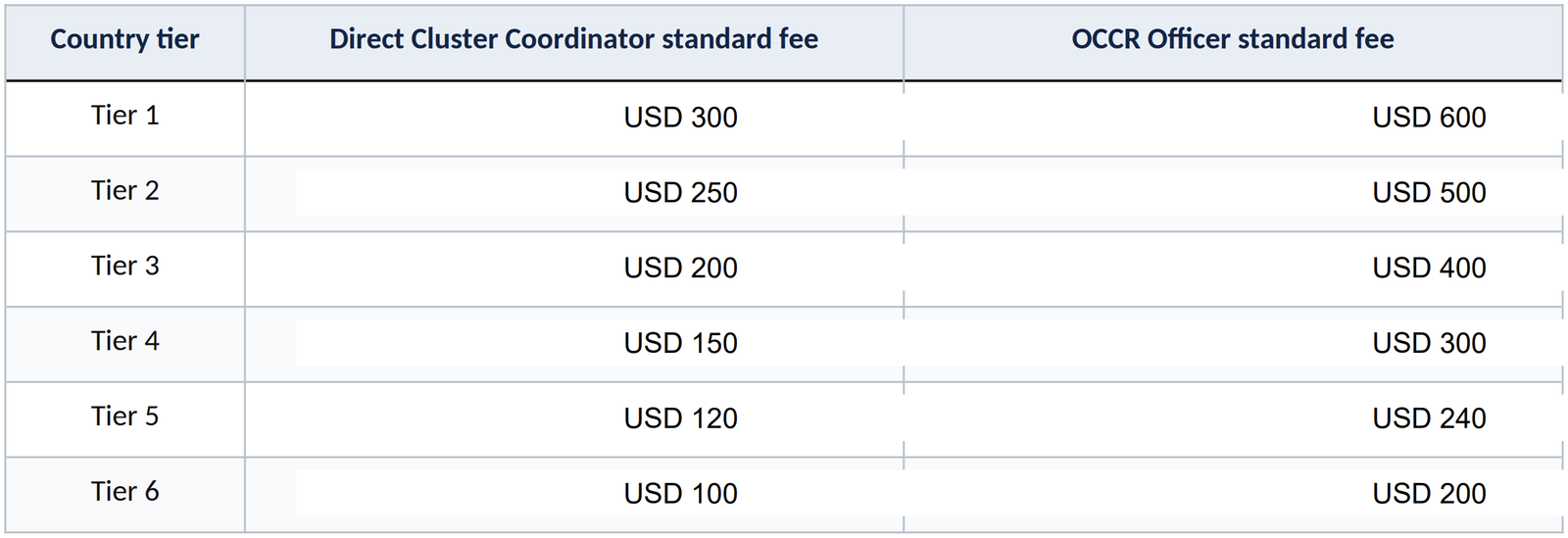
The OCCR standard fee is twice the corresponding Cluster Coordinator standard fee because the
programme includes deeper administration, customer-relations, supervisory and operational content
and a higher trainer-support entitlement.
40% Training Offer: 1 September to 30 November 2026
An applicant qualifies for the 40% training offer when the applicable payment is successfully completed
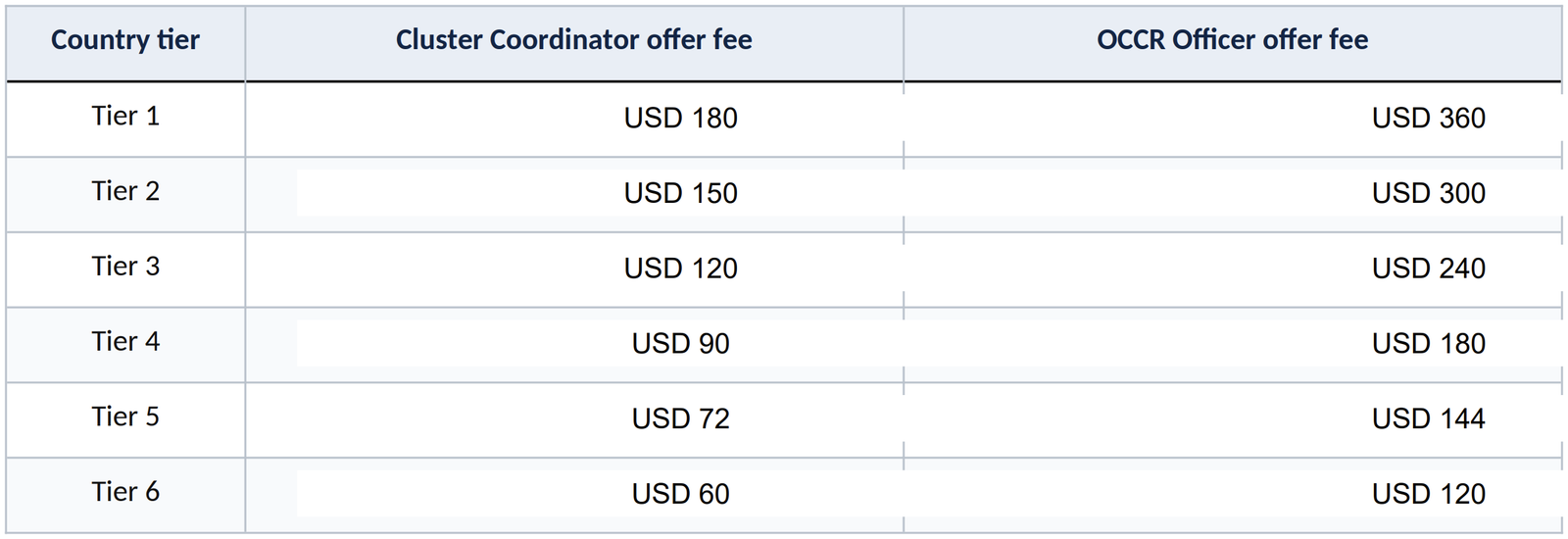
Offer eligibility is based on successful payment within the stated period. Training may commence later
under the normal activation and commencement rules. For example, a payment completed on 29
November 2026 remains eligible even if the approved training start date is in December.
Salary, Operational Grant and Performance Incentive
These are three separate financial components and must not be confused with one another.
Professional salary
Salary is compensation for eligible appointed staff under a valid appointment order or employment
agreement. Salary begins only after the applicable salaried appointment order becomes effective. It
does not begin during training, examination, interview or pre-appointment practical assessment.
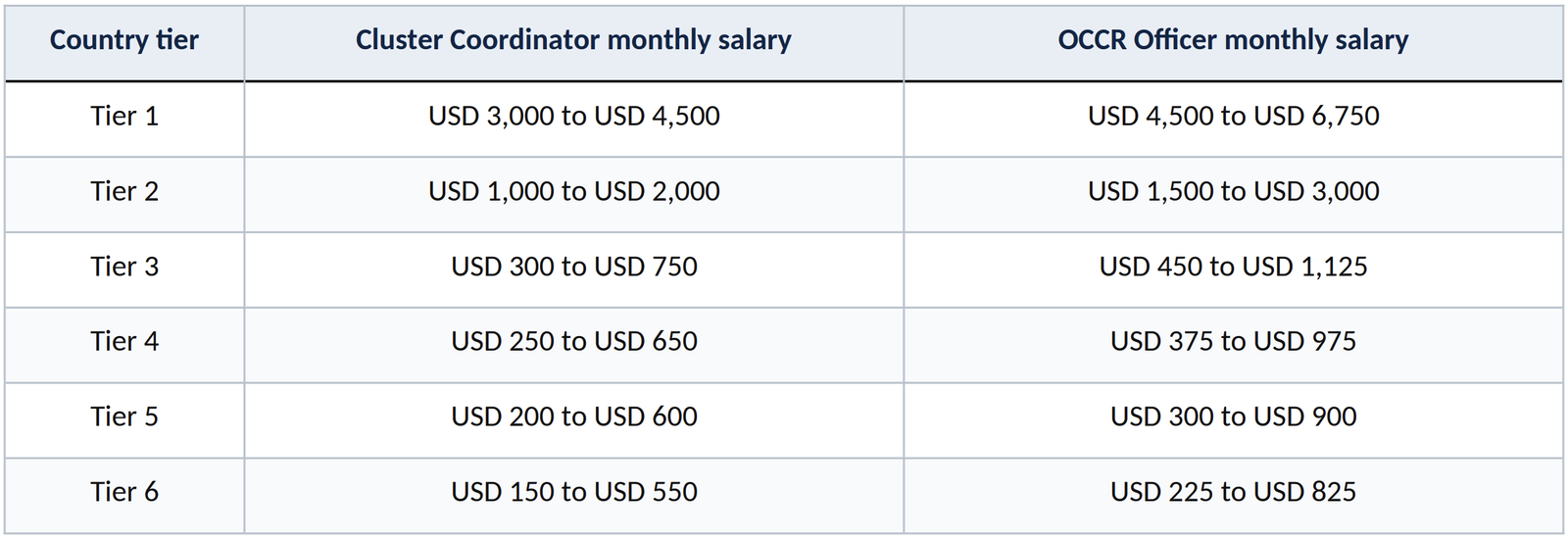
The OCCR salary range is 50% higher than the corresponding Cluster Coordinator range.
40% Training Offer: 1 September to 30 November 2026
An applicant qualifies for the 40% training offer when the applicable payment is successfully completed
USD 180 USD 360
USD 150 USD 300
USD 120 USD 240
USD 90 USD 180
USD 72 USD 144
USD 60 USD 120
These are policy ranges, not a guaranteed offer to every applicant. The exact employer, approved
location, currency, gross or net amount, benefits, deductions, schedule, duties and legal conditions must
appear in the applicable appointment order or employment agreement.
Operational grant or reimbursement
The operational grant is not salary and is not an automatic monthly payment. It supports verified and
approved official expenses.
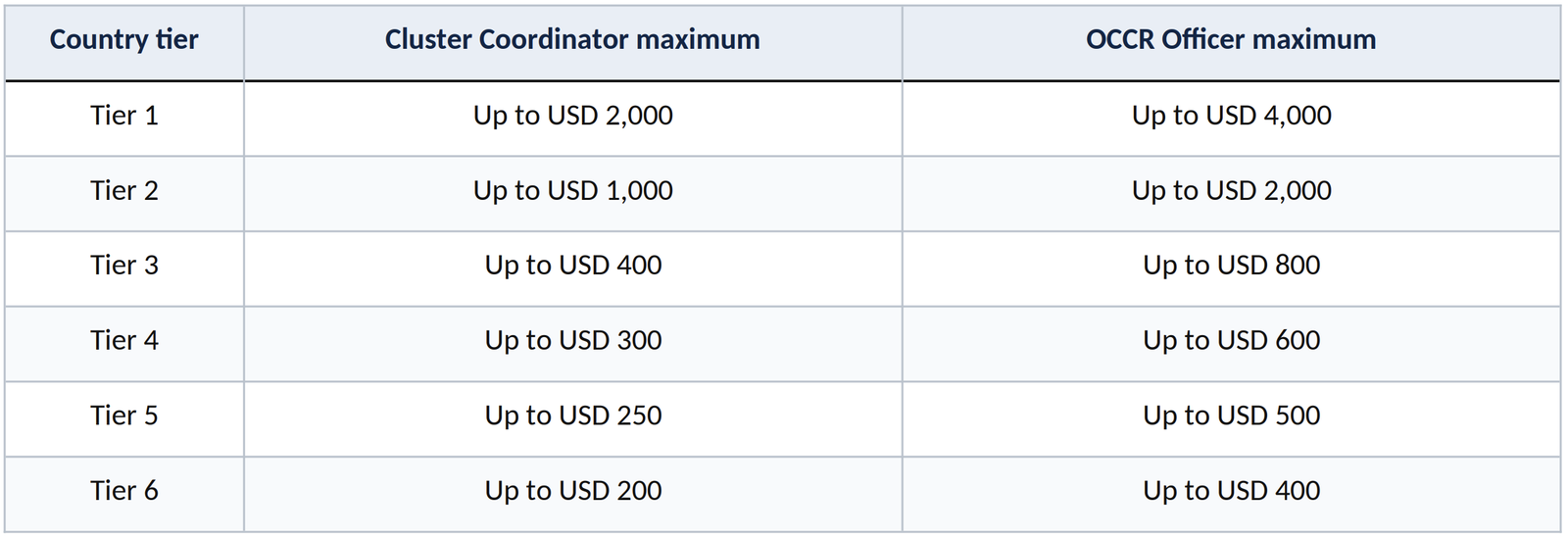
The OCCR maximum is 100% extra, or twice the corresponding Cluster Coordinator maximum.
Eligible costs may include authorised local transport, communication, internet, documentation, printing,
reporting and other approved field expenses. Approval depends on actual eligible cost, evidence,
location, necessity, prior authorisation, verification, budget and current policy. Personal or unauthorised
expenditure is not eligible.
Performance-based incentive
An incentive may apply separately to each eligible, completed, verified and approved service file or
authorised practical task. Assessment may consider:
• quality and accuracy;
• documentation completeness;
• processing time;
• policy and procedure compliance;
• customer-service standards;
• case-management performance;
• follow-up and closure quality; and
• final approval status.
Opening, submitting or counting a file does not create an incentive. The applicable service or task must
satisfy the current eligibility, completion, verification and approval conditions.
Settlement timing
During an authorised Institutional Learning Period, eligible settlements may be processed monthly so
the participant can understand the full workflow. After the applicable employment contract becomes
effective, eligible salary, grant, approved expenses and incentives may be processed weekly where
current settlement policy, system capacity and local law permit. No amount becomes payable solely
because a report or file was submitted.
Appointment, Institutional Learning Period and Confirmation
Appointment decision after practical approval
After the candidate completes every applicable assessment and practical requirement and receives the
required Department approval, the appointment decision and applicable order should normally be
completed within a maximum of 15 days.
The term Permanent Appointment Order may be used in the organisational progression process. Salary
begins from the effective date stated in the eligible salaried appointment order. However, the full 15-
year employment-protection framework and major long-term benefits activate only after successful
completion of the Institutional Learning Period and execution or activation of the applicable long-term
employment contract.
90-day full-salary Institutional Learning Period
The initial Institutional Learning Period or probation lasts 90 days.
During this period:
• the employee receives the applicable full salary;
• a Senior Officer provides guidance and operational support;
• the employee performs the authorised role under supervision;
• performance is assessed against the relevant SOP, policy, accuracy, conduct and responsibility
standards; and
• final approval authority rests with the responsible Department.
Major long-term benefits, including the 15-year employment-protection framework, are not yet fully
active during the initial probation stage.
Performance standard
Successful completion requires the employee to perform the authorised responsibilities accurately,
responsibly and consistently in accordance with the role description, policy and SOP. Assessment may
consider service quality, customer relations, reporting, safeguarding, confidentiality, operational
judgement, correction of errors, teamwork and authorised follow-through.
Salaried extensions
If performance is not yet satisfactory after the initial 90 days, the Department may approve:
• a first 30-day extension; and
• a second 30-day extension.
The maximum total extension is 60 days. Full salary continues during both approved extensions.
Targeted Retraining and Reassessment After Probation
First targeted retraining
If performance remains unsatisfactory after the approved extensions, the Department identifies the
specific weak or failed areas and requires targeted retraining.
The first targeted retraining:
• is free of charge;
• is unpaid;
• covers only the Department-identified weak or failed areas;
• may be organised in renewable 15-day blocks; and
• has a maximum duration of 60 days.
The employee is not required to repeat the entire syllabus unless the Department formally determines
that a wider repeat is necessary.
First reassessment after retraining
After successfully completing the first retraining, the person enters a 30-day full-salary departmental
reassessment. Successful Department approval activates the applicable long-term confirmation and
benefits.
Further paid targeted retraining
If the 30-day reassessment is unsuccessful, a further targeted retraining opportunity may be approved:
• fee: 50% of the applicable full standard training fee;
• content: only the Department-identified weak or failed areas;
• validity: 180 days; and
• next stage after successful retraining: another 30-day full-salary departmental reassessment.
Final decision authority
If the person remains unsuccessful after all approved probation extensions, retraining and reassessment
opportunities, the Office of the Chief Coordinator reviews the complete case and determines the final
outcome. The decision may consider performance, conduct, improvement, evidence, circumstances,
operational need and applicable law.
Long-Term Employment Framework and Benefits
After successful completion of the Institutional Learning Period and activation of the applicable employment contract, eligible staff enter the long-term employment framework.
15-year employment protection
The framework provides 15-year employment protection subject to the employment contract,
applicable policy, satisfactory conduct, lawful performance and valid disciplinary provisions.
The protection does not excuse fraud, misconduct, serious policy violation, unlawful conduct or another
valid ground for disciplinary termination.
Protection if DI cannot continue employment
If DI cannot continue the protected employment for normal organisational or structural reasons
unrelated to employee misconduct, the one-year job-protection amount is calculated as:
Last monthly salary plus regular fixed allowances, multiplied by 12.
Regular fixed allowances may include recurring accommodation or housing, family-related and other
fixed role allowances. The calculation excludes incentives, variable payments, reimbursements, one-time
bonuses and other non-fixed amounts.
The protection may be administered through the applicable organisational or insurance arrangement
stated in the governing employment documents.
Annual increment and other eligible benefits
The annual increment framework is 15%, subject to the applicable contract, continuing eligibility and
policy implementation.
Other eligible long-term benefits may include:
• family health-insurance support;
• a global-posting option where organisational need and legal conditions permit;
• the one-year job-protection arrangement described above; and
• an approved laptop or tablet and phone from the fourth month where required for the role.
The precise benefits, conditions, effective dates and exclusions are controlled by the employee’s
authorised appointment and employment documents.
Status and Document Meanings
Sympathiser activation
Confirms approval to perform the defined community-awareness and referral activities. It does not
confirm employment, salary, an exclusive area, case authority or professional authority.
Representative Volunteer registration
Confirms the recorded voluntary role under supervision. It does not confirm permanent appointment,
salary, a permanent cluster, immigration sponsorship or regulated professional authority.
Training or learning record
Confirms enrolment in or completion of the named learning and assessment pathway. It does not
guarantee selection, employment, salary, authority or the existence of a funded vacancy.
Conditional offer or eligibility letter
Confirms only the conditional progression stated in that document. It is not a final appointment or
employment contract unless the document expressly says so and every condition has been fulfilled.
Appointment order or employment contract
Confirms only the employer, designation, status, location, compensation, effective date, duties and legal
conditions stated in the authorised document and current policy. No unofficial statement can add a
benefit or authority that is not included in the governing documents.
Professional Conduct, Safeguarding and Privacy
Every participant and employee must protect people from harm, exploitation, misinformation, political
misuse and unauthorised use of personal information.
Dignity and non-discrimination
Treat every person respectfully. Disability, illness, poverty, age, identity or personal circumstances must
not be used to stigmatise, pressure or exclude anyone.
Informed consent
Explain the purpose before recording, referring, photographing, collecting or sharing information.
Supported decision-making and accessible explanation must be used where appropriate.
Children and vulnerable adults
Follow the approved safeguarding route, avoid unsafe contact and escalate suspected abuse, neglect,
exploitation or immediate danger promptly.
Confidentiality and minimum data
Collect only what is required for the authorised purpose. Access and sharing must remain strictly role
based and use the approved system.
Document and digital security
Identity, health, financial and case records must not be stored in an unauthorised messaging group,
personal cloud account or unapproved device. Documents must be obtained and transmitted only
through the approved process.
Financial integrity
Do not collect unofficial fees, use a personal payment account, promise funding or claim influence over a
government, bank, employer, regulator or private decision.
Non-partisanship
Do not campaign, solicit political support, manipulate feedback or present an organisational opinion as
law.
Professional boundaries
Do not diagnose, prescribe, provide legal representation, approve credit, issue licences or perform
another reserved function without the required qualification, authorisation and assignment.
Conflict of interest
Disclose personal, family, political, commercial or financial interests that could affect a referral,
complaint, purchase or decision.
Media, photographs and personal stories
Do not publish a person’s image, story, document or location without informed permission and any
required organisational approval.
Fraud and misconduct reporting
Verify vacancy references, payment instructions and document requests. Preserve evidence and report
suspected impersonation, fraud or misconduct through the authorised route.
Correction and accountability
Correct verified errors, notify affected persons where required, cooperate with authorised review and
protect complainants from retaliation.
Customer Relations Standard
Every authorised member must:
• explain what can and cannot be done before creating expectations;
• provide a reference and responsible next step when an enquiry is formally accepted;
• avoid guaranteeing a deadline controlled by a government, bank, employer, regulator,
professional or other third party;
• acknowledge complaints and provide a conflict-free escalation route;
• communicate material status updates accurately;
• keep a traceable record of agreed action; and
• close a matter only after recording the outcome, referral, reason for non-delivery, withdrawal,
ineligibility or continuing action.
Funding, Partnerships and Public Claims
Policy Brigade may receive lawful institutional allocations, grants, corporate social-responsibility
support, donations or other approved funding. A funding source, amount, partner, project, achievement
or impact figure may be published only after it has been verified, authorised and linked to an
accountable record.
No individual member may fundraise, collect a donation or receive money in the organisation’s name
without written authority.
No government, United Nations body, company, civil-society organisation, name or logo may be
described as a partner, sponsor or endorser without verifiable authority and approved public evidence.
Payment and Recruitment Protection
No applicant may be asked to pay merely in exchange for employment.
Any authorised payment must:
• relate to a clearly identified registration, identity card, training, academic or professional service;
• be communicated through an official channel;
• be paid only to an authorised account;
• be supported by an official acknowledgement or receipt; and
• be accompanied by the applicable service description and conditions.
A separately requested service must be independently described and officially invoiced. Payment must
never be presented as a guarantee of selection, salary, cluster allocation, visa, sponsorship or
employment.
If anyone promises guaranteed employment for an unofficial payment, stop the process and contact the
Global Helpline for verification.
How to Apply and Begin
Step 1: Choose the correct pathway
Choose Sympathiser, Representative Volunteer, direct Cluster Coordinator or OCCR Officer according to
the intended role and learning route.
Step 2: Submit an expression of interest or vacancy application
Community participation may begin through an expression of interest. Employment progression must
follow the applicable announced or authorised selection process.
Step 3: Provide the initial profile
The initial submission should include, where applicable:
• full name and safe contact details;
• country, state or province, district, city and residential locality;
• preferred role and pathway;
• preferred language and communication method;
• education and professional experience, if any;
• current employment status and availability;
• relevant skills, community involvement and local-area knowledge;
• any accessibility or reasonable-accommodation requirement;
• an updated curriculum vitae where available; and
• a short explanation of why the person wishes to participate.
Step 4: Complete suitability and verification
Complete the applicable identity, residency, area, role, document, background and communication
checks. OCCR applicants must also demonstrate the compulsory English, communication and computer
abilities.
Step 5: Complete the applicable learning route
• Sympathiser or Representative Volunteer: approved self-study and practical activity.
• Direct Cluster Coordinator: mandatory structured programme and trainer-supported learning.
• OCCR Officer: mandatory advanced structured programme, including administration and customer
relations.
Step 6: Complete formal assessment and practical work
Complete the applicable readiness evaluation, written examination, interview, practical files or
operational points.
Step 7: Accept conduct and reporting conditions
Accept the code of conduct, confidentiality, privacy, safeguarding, non-partisanship, professional
boundary and reporting requirements.
Step 8: Receive written activation or appointment
The written document must identify the approved role, legal status, area, supervisor, effective date,
permitted systems and whether the relationship is community participation, volunteering, learning,
provisional engagement or employment.
Step 9: Begin only after official activation
No identity card, payment, training completion or informal message independently authorises public
facing work or employment. Begin only after the official activation or appointment takes effect.
Official Application and Verification Contacts
Application email: Application@di-ngo.org
WhatsApp and Global Helpline: +971 58 975 1369
Website: https://un-ngo.org/
Policy Brigade page: https://un-ngo.org/policy-brigade/
Do not send a passport, medical record, bank statement, payment-card information or another highly
sensitive document with the initial expression of interest. Submit additional documents only after an
authorised officer explains the purpose and secure submission method.
An authorised Recruitment Counsellor may review the profile and explain the suitable pathway,
eligibility, training, practical assessment, appointment process, compensation framework, documents,
available area and applicable fee for a separately requested service.
Important Public Notice
This framework does not itself constitute:
• a guaranteed vacancy;
• a guaranteed appointment;
• an employment contract;
• a guaranteed salary;
• a guaranteed operational grant;
• a guaranteed incentive;
• a guaranteed exclusive cluster;
• a visa or immigration sponsorship promise; or
• a guaranteed international posting.
All appointments, benefits, settlements, operational assignments and progression decisions remain
subject to eligibility, verification, assessment, approved work, conduct, availability, organisational
requirements, Department approval, formal documentation, current policy, professional licensing where
applicable and local law.
Our Philosophy
A person’s value is not measured by the amount they pay. Commitment, integrity, sincerity, willingness
to learn, professional conduct, service quality and positive community impact determine long-term
progress.
Service is more important than status. Commitment is more important than designation. Competency
must always accompany responsibility.
Policy Brigade’s strength is not the number of claims it makes. It is the quality of each local relationship,
the accuracy of the information provided and the responsibility with which every accepted enquiry is
followed through.
Understand the need. Verify the pathway. Connect the right support. Follow through with dignity.
Achievements
Want to make a difference?
Come join us for endless opportunities, where your passion meets purpose, creating positive change together.
Our partners